PRIME: Probe-Based Identification of Metal-Binding Sites Using Deep Learning Representations
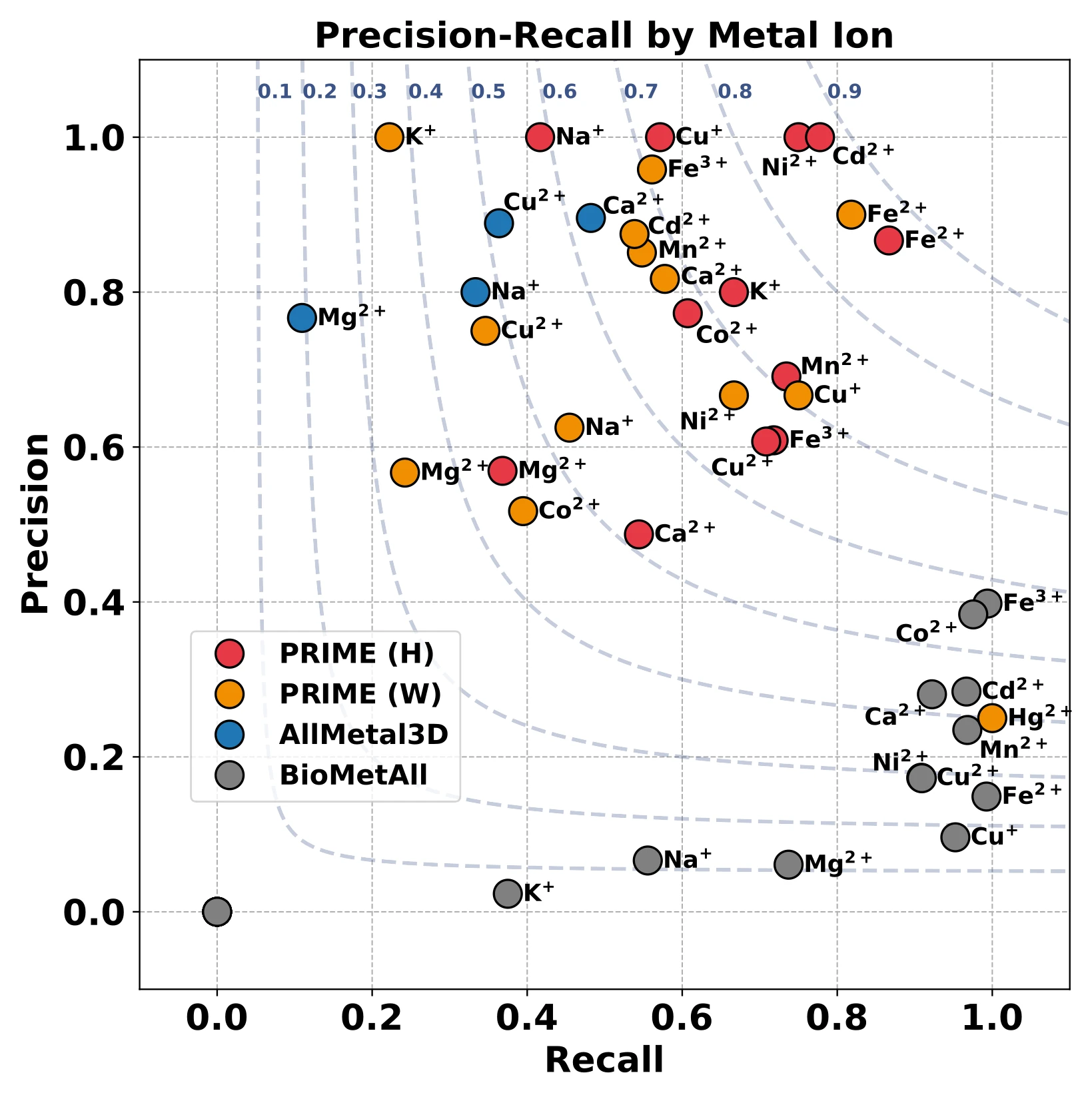
PRIME[1] is a hybrid deep learning framework that predicts metal-binding sites in proteins by combining protein language and structure models with a probe-based scanning algorithm. It outperforms existing methods across diverse metal ions and scales to AlphaFold2 and cryo-EM models.
Run a Prediction
Upload a structure file (PDB / CIF) or give a PDB / UniProt ID, pick a metal ion, and submit. Each run opens a dedicated, bookmarkable result page.
Click elements in the periodic table to choose one or more metal ions to scan. Only highlighted elements are supported; Fe and Cu add both oxidation states (refine them in the list below).
Alkali metal
Alkaline earth
Transition metal
Post-transition
Metalloid
Nonmetal
Halogen
Noble gas
Accepts PDB, CIF, or ENT format.
or
PDB structures are fetched from RCSB[2]; UniProt accessions use the AlphaFold2[3] model.
Examples from the paper:
Random orientations each probe is scored at (averaged). Higher = more robust, but linearly slower. Default 5.
Predictions currently run on a CPU server, so a typical job takes a few minutes. The result page shows live progress, can be bookmarked or shared, and is retained for one week.
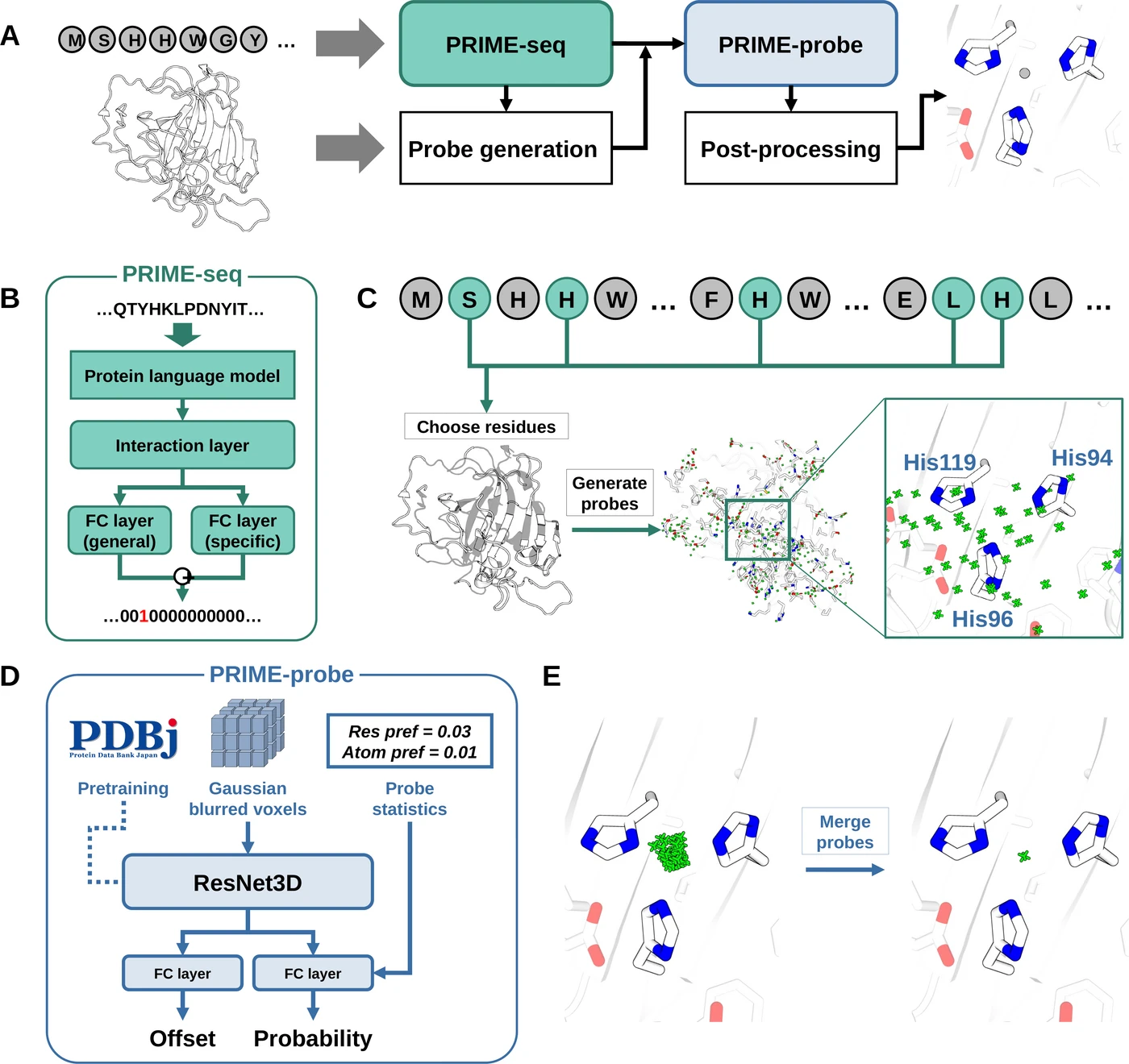
How PRIME Works
Performance
Supported Metal Ions
Transition metals
Zn2+Mn2+
Fe3+Fe2+
Cu2+Cu+
Co2+Ni2+
Cd2+Hg2+
Alkali & alkaline-earth metals
Ca2+Mg2+
Na+K+
References
- ^ Xu, S.; Onoda, A. Probe-Based Identification of Metal-Binding Sites Using Deep Learning Representations. bioRxiv 2025. DOI: 10.1101/2025.10.04.680417
- ^ Berman, H. M.; Westbrook, J.; Feng, Z.; Gilliland, G.; Bhat, T. N.; Weissig, H.; Shindyalov, I. N.; Bourne, P. E. The Protein Data Bank. Nucleic Acids Res. 2000, 28 (1), 235–242. DOI: 10.1093/nar/28.1.235
- ^ Jumper, J.; Evans, R.; Pritzel, A.; Green, T.; Figurnov, M.; Ronneberger, O.; Tunyasuvunakool, K.; Bates, R.; Žídek, A.; Potapenko, A.; et al. Highly Accurate Protein Structure Prediction with AlphaFold. Nature 2021, 596 (7873), 583–589. DOI: 10.1038/s41586-021-03819-2
- ^ Dürr, S. L.; Rothlisberger, U. AllMetal3D: Joint Prediction of Localization, Identity and Coordination Geometry of Common Metal Ions in Proteins. bioRxiv 2025. DOI: 10.1101/2025.02.05.636627
- ^ Dürr, S. L.; Levy, A.; Rothlisberger, U. Metal3D: A General Deep Learning Framework for Accurate Metal Ion Location Prediction in Proteins. Nat. Commun. 2023, 14, 2713. DOI: 10.1038/s41467-023-37870-6
- ^ Sánchez-Aparicio, J.-E.; Tiessler-Sala, L.; Velasco-Carneros, L.; Roldán-Martín, L.; Sciortino, G.; Maréchal, J.-D. BioMetAll: Identifying Metal-Binding Sites in Proteins from Backbone Preorganization. J. Chem. Inf. Model. 2021, 61 (1), 311–323. DOI: 10.1021/acs.jcim.0c00827
Please contact shijie.xu@ees.hokudai.ac.jp for any questions.
Changelogs
- 2026-09-18Major speed-up: predictions now run ~3× faster on GPU.
- 2026-05-28Updated web interface with interactive 3D visualization.
- 2025-10-01First release.